













Why Do Enterprises Struggle to Keep Digital Identity and Physical Access in Sync?
An employee joins the organization. HR records the employee, IT establishes the digital identity, and business applications are assigned according to role. At the same time, the security team determines which building, floor, parking area, or restricted zone that employee is authorized to enter.
At onboarding, both access environments may appear aligned.
The challenge becomes visible when something changes. The employee moves to another department, transfers to a different location, changes responsibilities, or leaves the organization. Digital permissions follow the Identity and Access Management process. Physical permissions follow the physical access control process.
When these environments operate independently, the enterprise risks maintaining two different access states for the same person.
For IDCUBE, the issue is not IAM versus physical security. It is how identity management and access control remain aligned throughout the identity lifecycle.
Why do digital identity and physical access become disconnected?
The separation often begins with different systems and different operational owners.
HR maintains employment and organizational information. IT and cybersecurity teams govern digital identities, directories, authentication, and application permissions. Security and facility teams manage credentials, access points, schedules, zones, and physical permissions.
Each function serves a distinct purpose. The gap appears when an identity change is reflected in one environment but not in the physical access workflow.
IDCUBE addresses the physical side of this problem through an integration framework that includes HRMS/payroll, Single Sign-On, CRM, ERP, business intelligence, and tenant and facility-management platforms. The same framework connects the physical security ecosystem with controllers, biometric devices, readers, elevators, video management, intercom, intrusion systems, and other supported systems.
This is where connected IAM and access control become an enterprise lifecycle requirement rather than two isolated technology functions.
What does IAM manage across the identity lifecycle?
Identity and Access Management governs digital identities and their access to enterprise IT resources.

It establishes the digital identity context, authenticates the user, assigns or changes digital entitlements, and removes access when the identity no longer requires it.
The distinction between authentication and authorization matters.
- Authentication answers: Who is this identity?
- Authorization answers: What is this authenticated identity allowed to access?
For example, IAM determines whether an employee receives access to email, ERP, CRM, or another enterprise application.
It does not determine whether that employee is permitted to enter a data center, finance floor, warehouse, laboratory, or another controlled physical area.
That decision belongs to physical access control.
How does IDCUBE extend identity into the physical environment?
Access360 Core manages the physical access layer by translating organizational access requirements into credentials, access rights, schedules, zones, and access-point rules.
IDCUBE’s foundational framework includes access-right modeling, access-point modeling, logical zoning, temporary access, inter-facility access, elevator groups, occupancy controls, anti-passback, door interlocking, and other physical access functions.
The platform also supports multiple credential types, including biometrics, RFID cards and vehicle tags, PINs, and virtual credentials such as static or dynamic QR, BLE, and NFC.
The distinction between IAM and physical access therefore remains clear:
| What is being decided? | IAM | Physical access control |
| Who is the person? | Digital identity, account, and role | Person, credential, and access profile |
| What can they access? | Applications, systems, and data | Buildings, floors, zones, and access points |
| What permission is assigned? | Digital access rights | Physical access rights and schedules |
| Where is access checked? | Application or digital service | Reader, controller, or access point |
| What changes over time? | Digital access is added, changed, or removed | Physical access is issued, changed, suspended, or revoked |
The same person exists in both environments, but access is enforced differently.
What happens when identity changes do not reach physical access?
Consider an employee who moves from operations to finance.
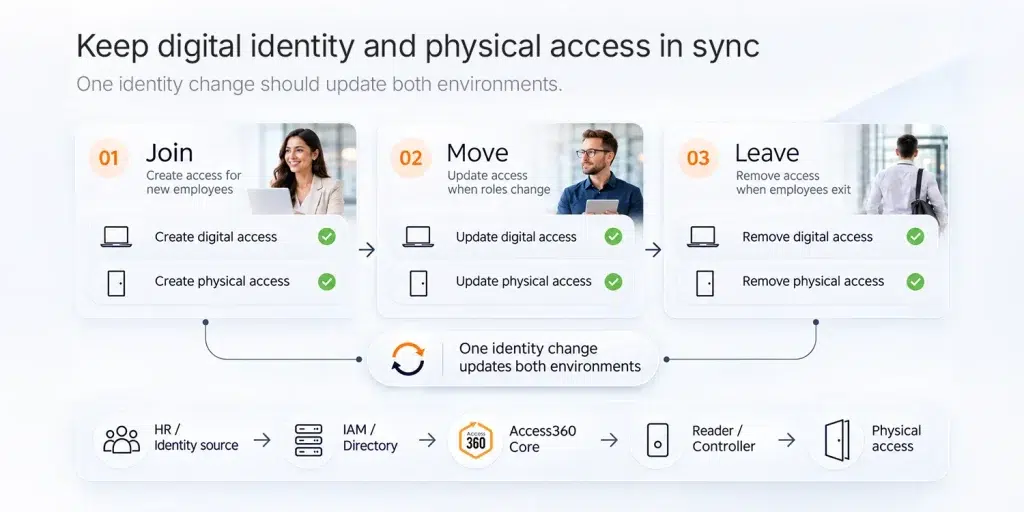
The digital identity receives new application entitlements. If physical access follows a separate process, access to the previous operational area remains unchanged until the corresponding physical permission is updated.
The same problem appears during offboarding. IT closes digital access, while a separately managed physical credential remains active until security processes the change.
Contractor access creates another common lifecycle challenge. The assignment ends, but physical access follows a different expiry or approval record.
These are not failures of IAM or physical access control individually. They are identity-lifecycle synchronization gaps.
For the enterprise, the impact is practical: more manual administration, outdated permissions, inconsistent records, and additional effort during security reviews and investigations.
This gap becomes most visible across joiner, mover, and leaver events, where one identity change should update both digital and physical access.
How should IAM and physical access control work together?
IAM and physical access control do not need to become the same system.
They need a controlled connection between digital identity context and physical access policy.
Relevant identity information enters the physical access workflow through supported integrations. Access360 Core then applies the physical rules that belong to the facility, including access rights, schedules, zones, temporary access, credential requirements, and access-point policies.
IAM remains responsible for digital identity governance.
Access360 Core remains responsible for physical access management and enforcement.
This separation of responsibilities keeps access management control clear while allowing both environments to remain aligned around the same organizational identity.
How does IDCUBE support the identity lifecycle beyond access assignment?
Physical access management does not end when a credential is issued.
Access360 Core supports credential lifecycle reporting, access reports, operator audit, and report scheduling, giving security teams visibility into how physical access is administered over time.
It also provides security intelligence through insider threat analysis, security gap analysis, and event analytics, helping teams review access activity and identify areas that require further investigation.
This gives enterprises a clearer view of whether credentials and physical access rights continue to reflect current organizational requirements after the initial access decision.
One identity should lead to consistent access decisions
Enterprises struggle to keep digital identity and physical access in sync because the same person exists across systems owned by different teams and governed by different workflows.
IDCUBE addresses the physical side of that problem by connecting supported enterprise identity sources with credentials, access rights, schedules, zones, readers, controllers, and reporting.
The objective is straightforward: when an employee’s organizational status changes, physical access should reflect the same business intent as digital access.
That is where connected identity management and access control become part of a consistent enterprise identity lifecycle rather than two separate records of the same person.