












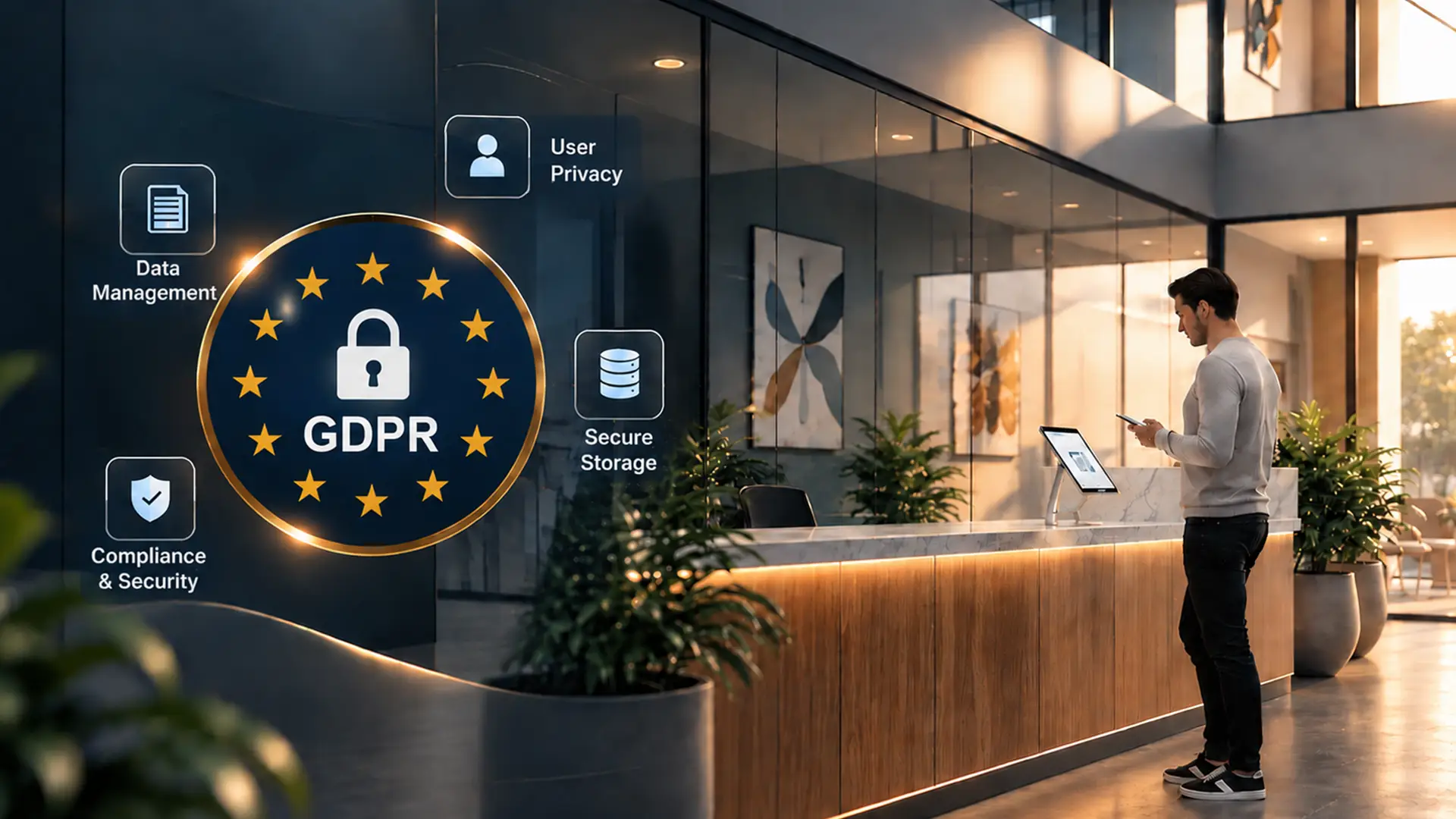
GDPR Compliance in Visitor Management: A Complete Guide 2026
- What Is GDPR and Why Does It Matter?
- What Does GDPR Have to Do With Visitor Management?
- How to Ensure Your Visitor Management System Is GDPR Compliant
- Why Digital Visitor Management Makes This Easier
- How IDCUBE Supports GDPR-compliant Visitor Management
- Implement VMS to Protect Visitor Data
- FAQs
Your Digital Visitor Log Could Be Putting Personal Data at Risk!
Think about your front desk.
A visitor walks in. They write down their name, company, phone number, and the person they’re meeting.
Maybe you also collect an ID number, photograph, signature, vehicle details, or check-in and check-out time.
It looks harmless.
But here’s the thing: every one of those details can become personal data or Personally Identifiable Information (PII) that your organization is responsible for protecting.
And if you’re using a paper visitor log (or paper visitor books), there’s another problem.
Anyone standing at the reception desk may be able to see information entered by visitors before them. Finding one person’s record later can be difficult. Correcting it can be harder. Deleting it when you no longer need it? That’s even more complicated.
A digital visitor management system solves some of these problems. But simply going digital doesn’t make you GDPR compliant.
If your organization processes Personally Identifiable Information (PII) covered by the General Data Protection Regulation (GDPR), you need to think about privacy from the moment you collect visitor information to the moment you delete it.
So, what does that actually look like?
Let’s break it down.
What Is GDPR and Why Does It Matter?
GDPR is the short form for the General Data Protection Regulation. It is a European Union (EU) data protection law that sets rules for how organizations collect, use, store, and protect personal data.
In simple terms, GDPR gives people more control over their personal information and requires organizations to handle that information responsibly.
This matters because the consequences of poor data protection can be significant. In 2019, France’s data protection authority, CNIL, fined Google €50 million over issues including lack of transparency, insufficient information, and invalid consent in its processing of personal data.
What Does GDPR Have to Do With Visitor Management?
Visitor management is directly connected to this because the visitor journey can involve several types of personal data.
For example, you might collect:
- Name and contact details
- Company and job information
- Photograph
- Identification details
- Signature
- Vehicle information
- Visit purpose
- Host information
- Check-in and check-out records
Now ask yourself five simple questions:
- Why are we collecting this information?
- Do we really need all of it?
- Who can access it?
- How long should we keep it?
- What happens when we no longer need it?
Those questions are at the heart of privacy-conscious visitor management.
“Privacy affects trust, not just compliance. Cisco’s 2024 Consumer Privacy Survey found that 3 out of 4 consumers would not purchase from an organization they don’t trust with their data.”
How to Ensure Your Visitor Management System (VMS) Is GDPR Compliant

1. Collect Only the Data You Actually Need
Start with the purpose of the visit.
A visitor coming for a 30-minute business meeting may only need to provide basic information.
A contractor entering a restricted facility may need additional information for security or safety purposes.
The point is simple: don’t collect information just because your system lets you collect it.
Review every registration field and ask whether it has a clear purpose.
This is the principle of data minimization in practice.
2. Tell Visitors What You’re Doing With Their Data
Visitors shouldn’t have to guess why you’re asking for their information.
Give them clear information about:
- What data you’re collecting
- Why you’re collecting it
- How it will be used
- How long it will be retained
- Who may access it
- What rights they have
And don’t assume that every visitor record requires consent.
GDPR provides several possible legal bases for processing personal data. The right basis depends on the purpose and circumstances of the processing.
3. Control Who Can See Visitor Information
Not everyone needs access to every visitor record.
Reception staff may need to see today’s visitors.
A host may only need information about their own guests.
Security personnel may need to know who is currently inside the facility.
Historical records may only need to be available to authorized administrators.
Role-based access and least-privilege controls can help reduce unnecessary exposure.
4. Set Clear Retention and Deletion Rules
Here’s a common mistake: collecting visitor data and then keeping it forever.
GDPR does not provide one universal retention period for every visitor record.
Instead, organizations need to determine how long information should be retained based on its purpose, applicable legal requirements, and operational needs.
Then comes the important part.
You need a process for deleting information when you no longer need it, while documenting any legitimate exceptions.
A visitor record shouldn’t live in your database simply because nobody remembered to remove it.
5. Protect Visitor Information
Visitor information needs protection throughout its lifecycle.
When evaluating a visitor management system, look at controls such as:
- Role-based access
- Authentication
- Secure data storage and transmission
- Audit logs
- Backup and recovery controls
- Data deletion processes
- Security incident procedures
The goal isn’t just to know who entered your building.
It’s to protect the information you collected about them.
Pro-tip: If a third-party provider processes visitor information for your organization, you should also review applicable contractual and data-processing requirements.
Depending on the processing involved, your organization may also need to consider requirements such as a Data Processing Agreement (DPA) or a Data Protection Impact Assessment (DPIA).
Why Digital Visitor Management Makes This Easier
Paper visitor books can expose personal information and make visitor records difficult to manage. Digital visitor management provides greater control over how visitor information is collected, accessed, stored, and deleted.

Let’s understand this with the comparison table: Paper visitor book vs. digital visitor management
| GDPR area | Paper visitor book | Digital visitor management |
| Privacy & access | Previous visitor details may be visible to others. | Visitor data can be restricted to authorized users. |
| Data retention | Records must be reviewed and removed manually. | Retention and deletion can be managed systematically. |
| Data requests | Finding or correcting specific records can be time-consuming. | Records can be searched, updated, or deleted more easily. |
| Transparency | Privacy notices and consent are harder to manage consistently. | Privacy notices can be shown to visitors during the registration process. |
How IDCUBE Supports GDPR-compliant Visitor Management
This is where a digital visitor management platform can make a practical difference.
IDCUBE ezvisit10 digitizes visitor registration, approval, verification, check-in, and check-out through ten predefined workflows.
Instead of relying on manual visitor books, organizations can maintain digital visitor records, control access to visitor information based on roles, and use reports and audit trails to improve visibility into visitor activity.
ezvisit10 can also integrate visitor workflows with physical access control, helping organizations manage visitor access as part of a broader security process.
The important distinction is that ezvisit10 simplifies visitor data management while giving you peace of mind with GDPR-compliant data handling.
Implement VMS to Protect Visitor Data
GDPR compliance isn’t about collecting as little information as possible.
It’s about collecting the right information for a clear purpose, protecting it properly, controlling who can access it, and removing it when you no longer need it.
Your visitor management process should protect two things at the same time:
Your facility and the people whose data you collect.
With the right processes and technology in place, you can create a visitor experience that’s easier to manage, easier to audit, and more respectful of personal data.
Want better control over visitor data? Contact us!
FAQs
What is PII?
Personally identifiable information (PII) is any information that can identify a person, such as their name, phone number, email address, photograph, ID details, or visit records.
IDCUBE’s digital visitor management system, ezvisit10, helps protect PII with encryption, data isolation, and built-in GDPR-compliant data handling.
Why is GDPR important for visitor management?
Visitor management involves collecting personal information. GDPR requires organizations to process that information lawfully, transparently, securely, and for defined purposes.
Who needs to follow GDPR?
GDPR applies globally to any organization handling the personal data of individuals located in the EU or EEA.
What visitor information is considered personal data?
Names, contact details, photographs, identification information, vehicle details, and visit records can be personal data when they relate to an identifiable individual.
How long should visitor information be retained?
There is no universal GDPR retention period. Organizations should define a period based on the purpose of processing, legal requirements, and operational needs.
Can a visitor management system help with GDPR compliance?
Yes. A properly designed platform, for example, IDCUBE’s ezvisit10 can support data minimization, controlled access, retention, deletion, security, and auditability. (However, software alone does not make an organization GDPR compliant).